

Pool surrounds are one of the hardest surfaces to spec. Full-day UV, constant splash, pool chemicals, bare feet, wide temperature swings — season after season.
Get the product wrong, and you’re back on-site. Get it right, and it’s a project you can point to for the next decade.
This guide covers the spec data, Australian standards, and practical install detail you need. It applies to any scale — from a suburban pool surround to a large commercial fitout.
Why Composite Decking Works Around a Pool
Pool decking takes more punishment than almost any other outdoor surface. The combination of UV exposure, moisture, and pool chemicals breaks down natural wood fast.
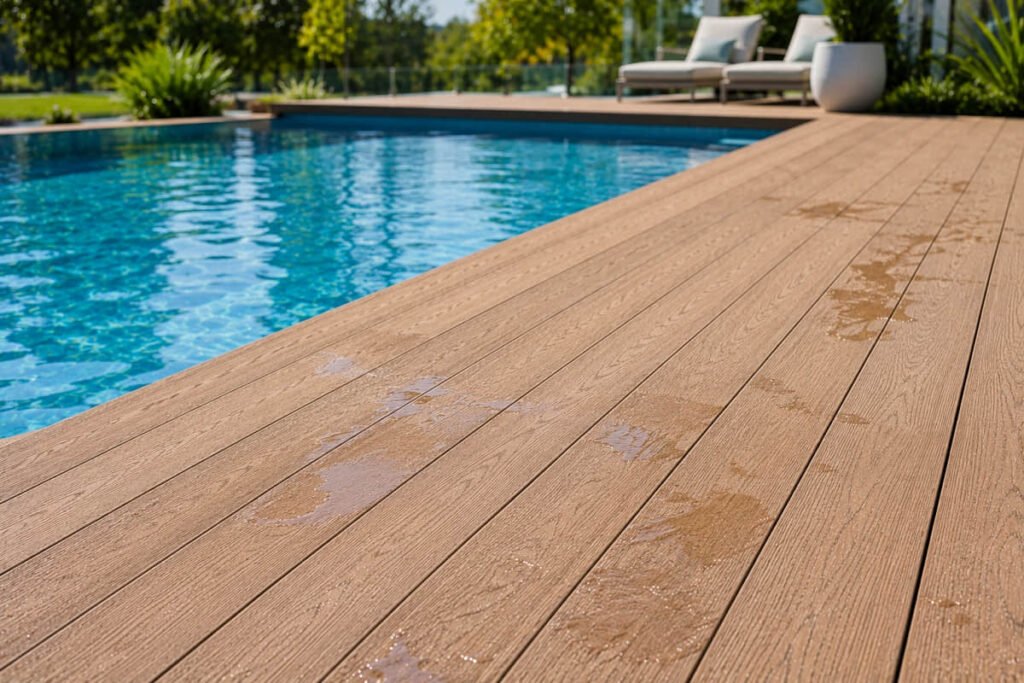
Composite decking handles this better. Tested to ASTM D1037, composite boards absorb just 0.2% water by weight — a water absorption rate far below untreated pine, which can soak up 30–40% of its own weight over time. That gap explains why composite performs so differently in a pool environment.
This wood plastic composite material blends wood fibres with plastic polymers — usually HDPE. The outer cap is the same polymer used in marine-grade products. It sheds water rather than soaking it in. Unlike natural wood, composite boards won’t check or crack at the surface. No splinters means barefoot traffic is safer from day one.
Mold growth is also worth noting. Timber pool decks in shaded or south-facing areas are prone to surface mould — especially in humid coastal climates. Low moisture absorption in composite boards gives mold very little to work with.
Ready to see the material up close? Request free samples before specifying — check colour, finish, and surface texture against your project brief.
Is Composite Slip-Resistant Around a Pool?
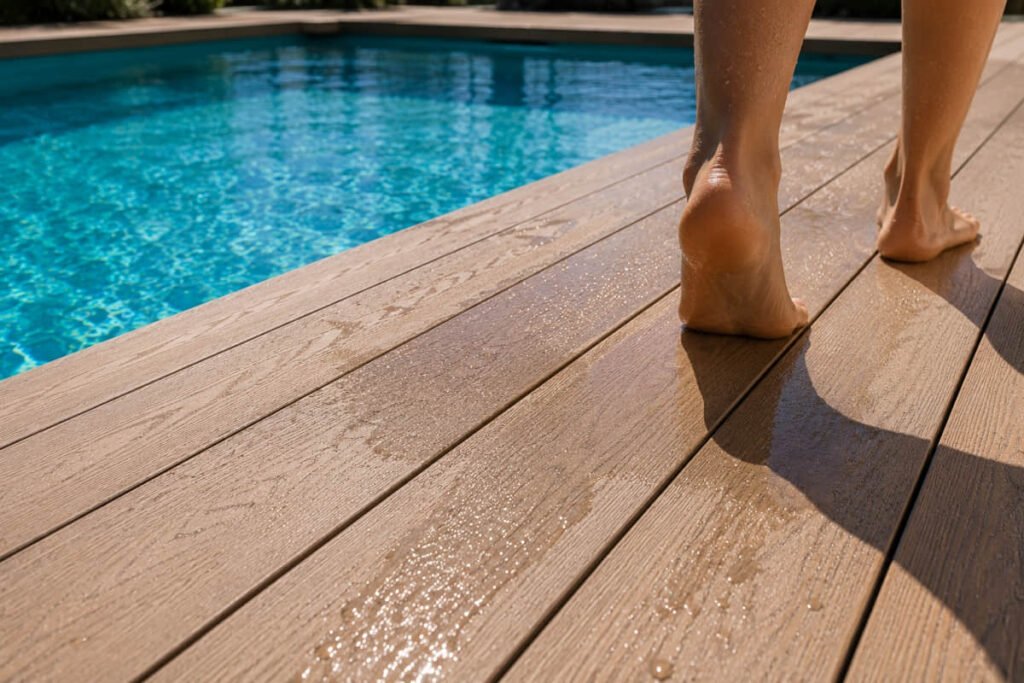
Safety around a pool is a compliance issue, not just a comfort one. Australian standard AS/NZS 4586 classifies surface slip resistance for wet external areas. Pool surrounds need at least R11 — the rating for wet barefoot use.
What slip rating is required for pool decking in Australia?
- AS/NZS 4586 covers external surface slip resistance across Australia and New Zealand
- R11 is the minimum for wet barefoot areas — pool surrounds, wet decks, and change areas
- R11 is referenced in NCC documentation for wet external surfaces near pools
- Testing follows the DIN 51130 ramp test method
LastElegance composite pool decking is rated R11 under AS/NZS 4586. The anti-slip texture is built into the board profile — not a surface coating that wears down with foot traffic or UV exposure over time.
Oiled or painted timber tells a different story. Those surfaces can drop well below R11 when wet, especially as the finish wears. On a pool deck, that’s a real liability concern for any builder or contractor.
How Hot Does Composite Get Around a Pool?
Composite decking absorbs heat in full sun — and dark colours get hotter than light ones. Worth saying clearly, because some suppliers skip it.
The practical call for pool surrounds: specify lighter colours in hot climates. A light grey or sandy tone runs much cooler underfoot than deep charcoal on a full-sun afternoon in Queensland or WA.
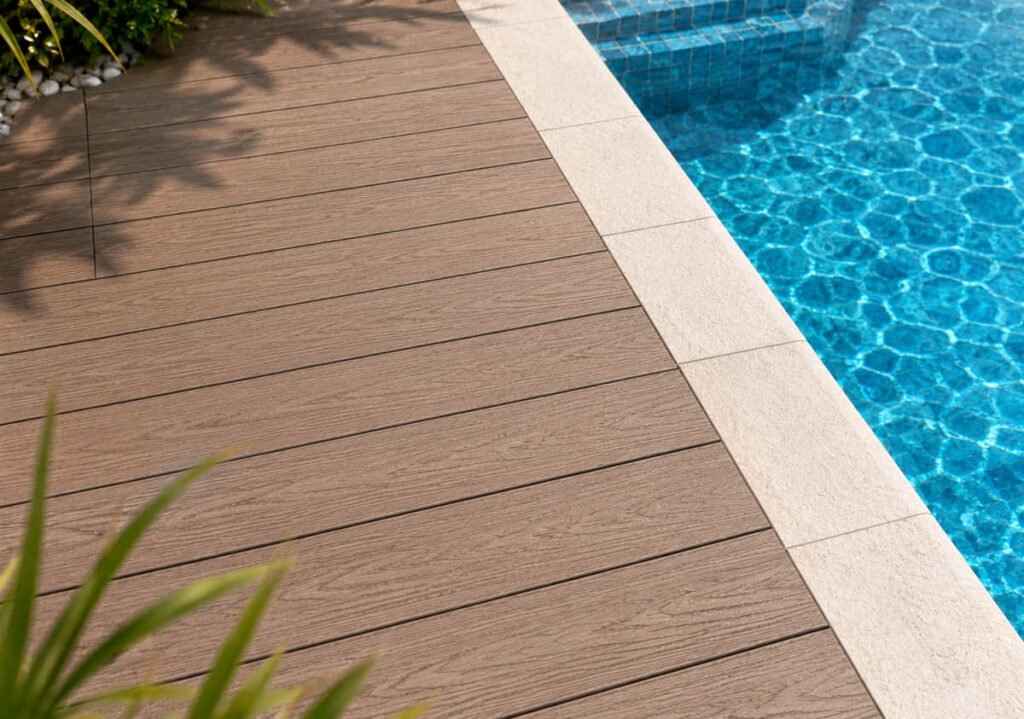
Two things work in composite’s favour here. The 0.8 mm cap layer moderates surface temperature compared to thinner-capped or uncapped boards. Heat stays at the surface rather than sinking into the core — so the board cools faster when shade or splash hits it.
Pool areas also benefit from natural evaporative cooling. Most builders and contractors in Queensland and northern NSW find the heat is far less of a client concern than expected.
If the pool deck faces full western afternoon sun with no shade structure, factor that into the spec. Lighter decking colours and some overhead cover make a real difference.
Does Composite Stand Up to Pool Chemicals?
Chlorine, salt, and pH adjusters break down traditional wood decking fast. They bleach the surface, speed up rot, and weaken the structure over time.
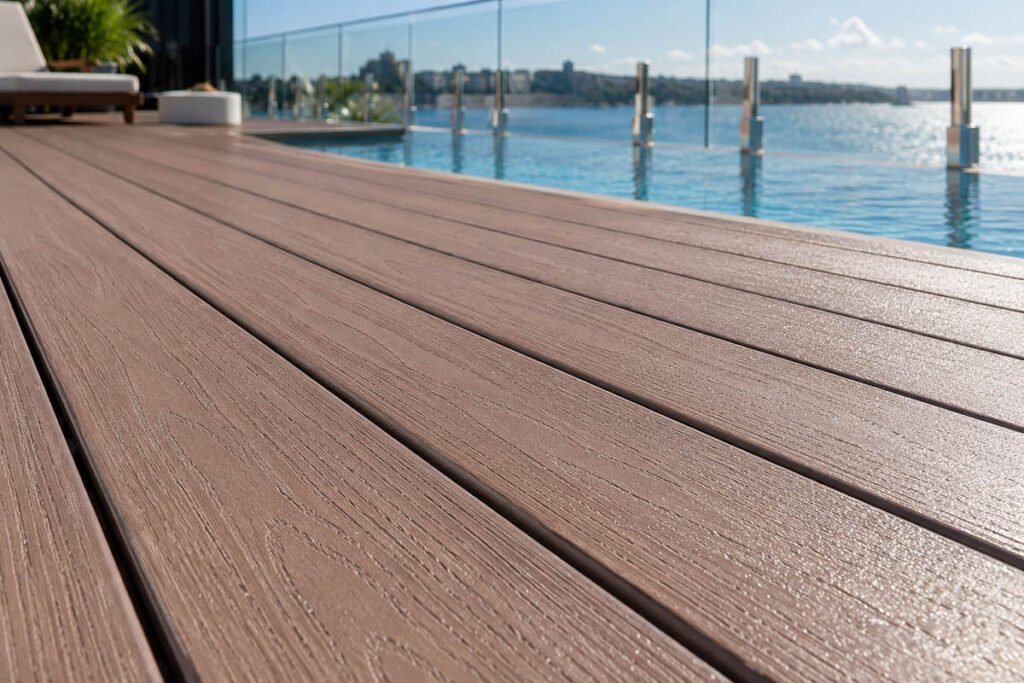
With a water absorption rate of just 0.2%, composite boards give pool chemicals almost nothing to work with. The HDPE outer cap — at 0.95 g/cm³ density — is chemically inert to the concentrations used in standard pools. No bleaching, no surface breakdown, and no colour leaching into the pool water that some treated timbers can cause.
This matters even more on commercial jobs. Resort pools, aquatic centres, and body corporate pools run higher chemical concentrations and longer contact times. When boards fail in that environment, the cost isn’t just materials — it’s labour, downtime, and the client relationship.
Composite removes that category of risk entirely.
Composite vs. Timber for Pool Surrounds
Composite costs more upfront. That’s true, and worth saying directly. But for a pool surround, the long-term picture changes the comparison.
Timber pool decks need re-oiling every 12–18 months under typical Australian conditions. Boards start cracking and splitting within a few years in high-UV, high-moisture environments. Most timber pool decks need board replacement at the 7–10 year mark — sometimes earlier in coastal or tropical climates.
Here’s how the materials compare on the factors that matter for a pool surround:
| Feature | Composite | Treated Pine | Merbau |
|---|---|---|---|
| Upfront cost per m² | Higher | Lower | Mid–High |
| Re-oil / re-seal frequency | Not required | Every 12–18 months | Every 12–18 months |
| Lifespan poolside | 15+ years | 7–10 years | 10–15 years |
| Slip rating (wet) | R11 — certified | Variable — drops when wet | Variable — drops when wet |
| Chemical resistance | High (HDPE cap) | Low — bleaches and rots | Low–medium |
| Termite resistance | Yes | Treated only | Natural resistance |
| Warranty | 15 years | None standard | None standard |
| Splinter risk | None | Yes — worsens over time | Yes — worsens over time |
For most residential and commercial pool projects, the real cost question is: a bit more now, or a lot more over 10–15 years in upkeep and replacement?
Colour Options for Pool Decking
For pool surrounds, two things drive colour choice at a trade level.
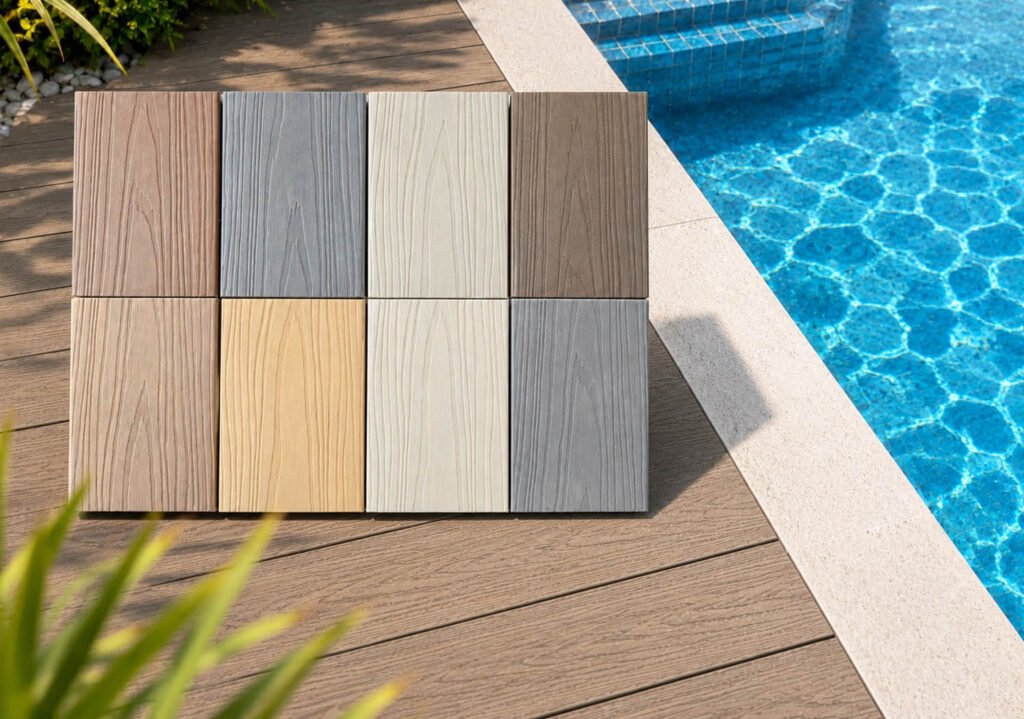
Surface temperature. Lighter colours reflect more solar radiation and stay cooler underfoot. In Queensland, WA, and northern NSW — anywhere with full-day summer sun — this is a practical spec call, not just an aesthetic one.
Colour stability over time. The combined HALS (Hindered Amine Light Stabilisers) and UV absorber system in our boards holds colour well. After 3,000 hours of QUV accelerated aging, colour variation (ΔE) stays within 4–5. That’s a slight, even fade — not patchy bleaching.
Our composite decking shares a colour palette with the cladding and screening ranges. If you’re specifying all three on the same outdoor space, the pool deck can match the other surfaces without a separate colour system. For commercial projects requiring a custom colour, contact us early — sample approval adds lead time, and building that into the project schedule avoids delays later.
Seeing colour on screen isn’t the same as seeing it on site. Order physical board samples to check how colours read next to pool tiles and landscaping before locking in the spec.
Australian Compliance for Pool Decking
Pool decking compliance covers more than the surface material. These are the key areas to check — and to raise with your building certifier.
What are the compliance requirements for pool decking in Australia?
- Slip resistance. Pool surrounds should meet AS/NZS 4586 R11 for wet barefoot areas. This is the standard referenced in NCC documentation for wet external surfaces near pools.
- Pool barrier requirements. The NCC and state-based pool safety regulations govern fence height, gate specs, and how pool decking interacts with pool barriers. The deck surface must not create footholds that allow access to the pool zone.
- Drainage. Pool decking needs a fall toward drainage — typically 1–2 mm per 100 mm of run. Board gap spacing must also allow water to move freely, not pool on the surface.
- BAL rating. In bushfire-prone areas, check the site’s BAL assessment before specifying. Composite boards carry an ASTM E84 fire test result (FSI: 85, SDI: 300) — confirm with your certifier whether this meets the site’s BAL requirement.
This isn’t legal compliance advice — your certifier signs off on that. But knowing the checklist means you arrive at that conversation ready, not after the spec is locked.
Procurement managers can use the R11 AS/NZS 4586 result and ASTM D1037 water absorption data directly in project specification documents. Both are in the technical data sheet.
Installing Composite Decking Around a Pool
Pool-area installation has a few specifics worth knowing — especially on high-traffic or commercial builds.
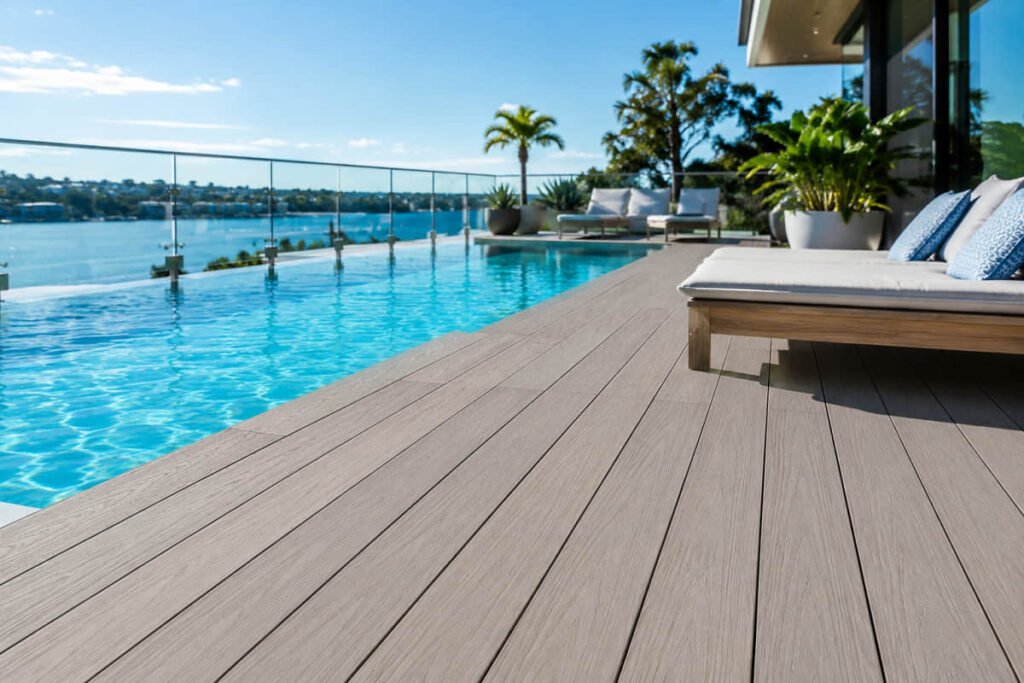
Joist spacing. Use 300–350 mm centre-to-centre for pool surrounds. That’s tighter than a standard deck because poolside surfaces handle more point loads — sun lounges, high foot traffic, water impact. Tighter spacing keeps boards stiff and prevents deflection over time.
Board direction. Run boards parallel to the pool edge where you can. This channels water away from the pool zone and looks cleaner from the waterline.
Gap spacing. Leave 5–8 mm between boards and at butt ends. Australian summer conditions create high surface temperatures — adequate gap spacing prevents buckling.
Fastener system. The hidden clip system uses stainless steel clips that slot into the board groove and fix to the joist. No surface screws — so there’s no fastener corrosion from pool water exposure. For pool surrounds, stainless steel is the right call. Don’t substitute standard steel fixings to save cost.
The easy installation process means two people can complete the job without specialised equipment. An installation video is available — ask your account manager.
Volume Supply, Custom Lengths, and Lead Times
For builders and contractors pricing up pool projects, here’s what you need to know about supply before the job starts.
Minimum order quantity. Supply starts at 100 m². This fits most residential and light-commercial swimming pool decking projects. For smaller trial orders, contact our sales team — we’ll work through the options.
Custom board lengths. Standard lengths work for most jobs. But irregular pool shapes or minimising on-site waste sometimes call for custom cuts. We can supply decking boards to custom lengths — flag this early in the quoting process so it’s built into production scheduling.
If you’re working to a fixed start date, factor that in when you place the order. On commercial pool projects where site dates are locked in, ordering early protects your programme.
Factory-direct pricing. LastElegance supplies factory-direct — no distributors between the factory and your order. That keeps pricing tighter than most comparable composite decking materials on the Australian market. The cost advantage passes directly to trade partners.
Pricing a pool project now? Request a quote with your volume, board dimensions, and timeline — we’ll come back with a number quickly.
Handing Over a Low-Maintenance Pool Deck to Your Client
Low maintenance is one of the strongest selling points of composite pool decking. Here’s how to communicate it at handover — and how to use it earlier in the sales process.
What to tell your client at handover:
- Summer: rinse weekly, full clean with soap and a soft brush every 3–6 months
- Commercial pools with higher foot traffic: light clean monthly, full clean quarterly
- No oiling, no sanding, no sealing — ever
That last point is what separates composite from traditional wood decking. Timber needs re-oiling every 12–18 months and full board replacement around year 7–10. Composite cuts that whole cycle out.
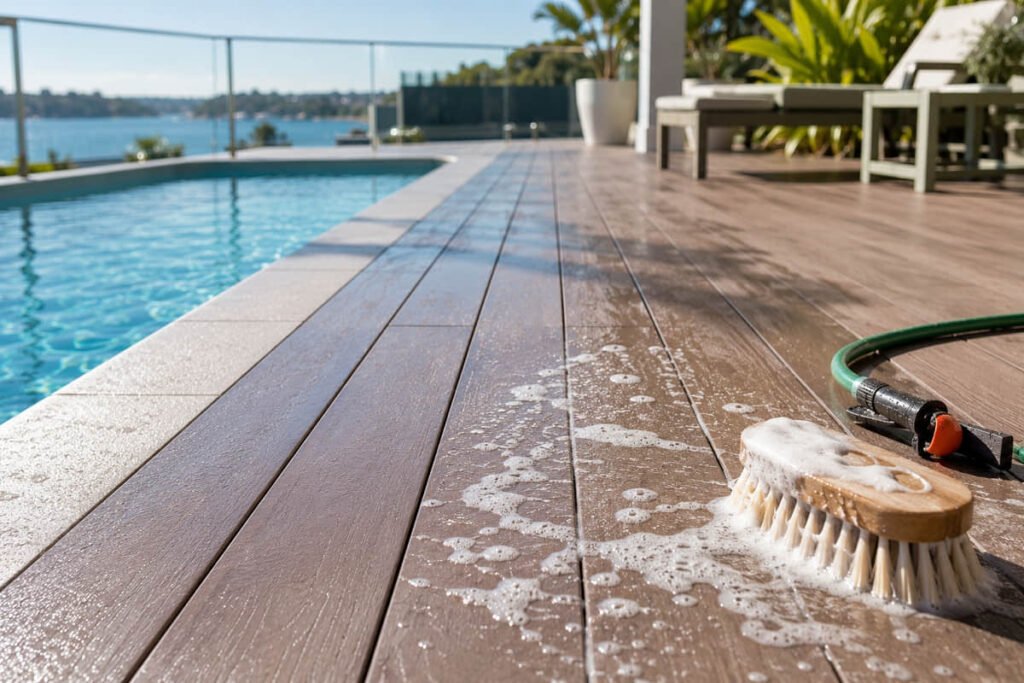
How to use this in your quote. When you’re competing against a cheaper timber pool deck quote, the low-maintenance case is your strongest argument. Lay out the real cost of ownership: oiling every year, sanding back every few years, replacing boards at year 7–10. Then compare it to composite — a 15-year warranty with no re-oiling schedule.
That’s a real cost advantage for your client, not just a features claim.
Preventing call-backs. The main things that build up on a pool deck are sunscreen residue, leaf tannins under nearby trees, and surface biofilm in shaded areas. None of these is hard to clean — but leaving them for months makes the job bigger. Pass the cleaning schedule to your client at handover. It’s the simplest way to prevent a call-back and keep the installation looking the way it did on day one.
FAQ
Is composite decking good for both inground and above-ground pools?
Yes — composite boards work well around both pool types. The subframe requirements differ slightly: above-ground pools often need a freestanding frame rather than a ground-bearing structure. But the boards, clips, and installation process are the same for both.
What is the best decking material for around a pool in Australia?
Capped composite is the most practical choice for most Australian pool surrounds. It meets AS/NZS 4586 R11 for wet barefoot areas, resists pool chemicals, and needs far less upkeep than timber. PVC and aluminium are worth considering for specific commercial applications, but composite handles most residential and light-commercial builds well.
Can you install composite decking over existing pool coping?
Generally not recommended. Composite needs a proper subframe to allow drainage, thermal movement, and load distribution. Laying boards directly over coping traps moisture underneath and may void the warranty. A raised frame allows proper water run-off and ventilation underneath.
Is composite decking prone to warping in the sun?
Capped composite with a 0.8 mm outer layer resists warping well. The key is leaving the right expansion gaps at installation — typically 5–8 mm between boards and at butt ends. This is especially important in Australian summer conditions, where surface temperatures can be high.
Does composite decking fade around a pool?
Modern capped composite uses HALS and UV absorbers to protect colour. After 3,000 hours of QUV accelerated aging, colour variation (ΔE) stays within 4–5, a slight, even fade rather than patchy bleaching. That’s well within the acceptable range for pool surrounds across a 15-year product life.
Ready to spec composite for your next pool project? Talk to our sales team about volume pricing, custom lengths, and current lead times.
